
Alpe d'Huez - ski resort overview
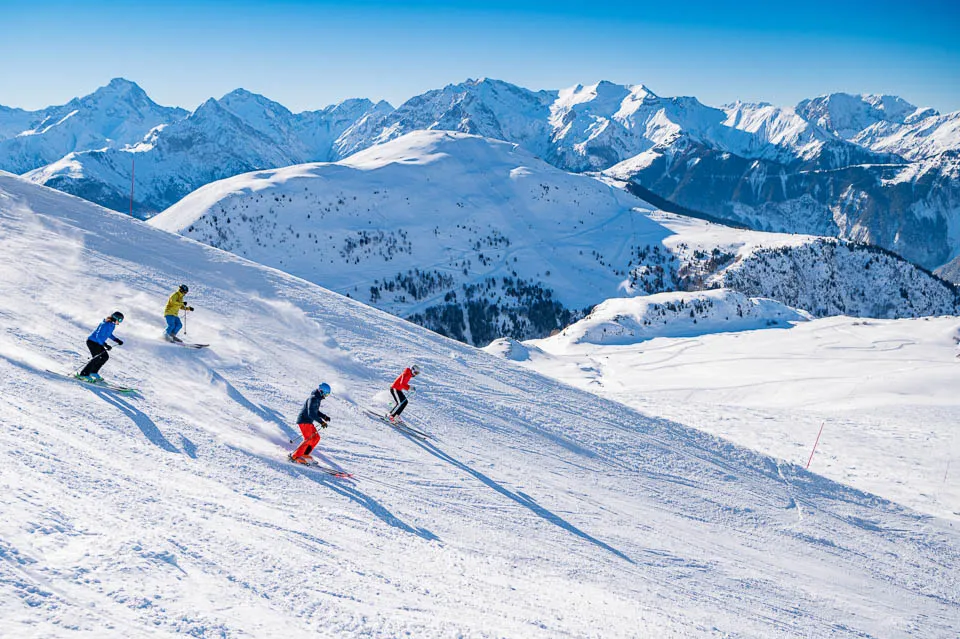
Deep in the Rhône Alps, Alpe d’Huez Grande Domaine has become one of France’s big resorts, in every way: extent, reputation, and history. Its vast ski area embraces several villages, ancient and modern.
Constant development, both on and off the slopes, has made Alpe d’Huez one of the world’s largest resorts with a great deal of appeal and a welcoming reputation. Going against the grain, the most recent developments have been in an attractive, traditional chalet style. Among French skiers and boarders, the resort is regularly voted among the country’s top five winter sports destinations. In 2026, it’s arguably on par with the likes of Val d’Isère – but thankfully, with less painful prices.
Alpe d’Huez has always been known for its excellent intermediate and beginner slopes. However, it has also become a magnet for expert skiers from all over the world. Freeriders are drawn to its wealth of high-altitude, steep terrain. From the top of Pic Blanc (3330m), four runs follow a vertical drop of 2000 metres (to Oz en Oisans, at 1135m).
 Photo: Daniel Elkan
Of course, Alpe d’Huez is famous not just for skiing: the resort is one of the main mountain elements in (and its steep hairpin bends one of the most testing features of) the Tour de France, and has been a stage finish almost every year since 1976. Its summer market has benefited from this connection – making it a truly year-round resort.
A final plus point is the high number of sunny days you can expect here in winter – hence the local expression: "When it’s not sunny in Alpe d’Huez, it must be night-time." All in all, you really can’t go wrong with Alpe d’Huez.
 Photo: Laurent Salino
Highlights
- Fabulous range of skiing, with particularly long runs
- Lift pass that covers five villages, 250km of groomed piste, and 75 lifts
- More sunny days than most French resorts
- Good selection of mountain restaurants
- Excellent and easily accessible nursery slopes
- Wide accommodation options and a choice of villages
Lowlights
- Some of the more popular intermediate runs can get crowded
- The high amount of sun on some slopes means they can get very worn towards the afternoon (although efficient snowmaking generally keeps runs open)
- Most skiing is above the tree line, so in bad weather visibility can be a problem
- Many tougher, more exciting runs are at high altitudes and are vulnerable to closure in bad weather

| Village altitude | 1860m |
| Ski altitude | 1125-3330m |
| Ski area | 250km |
| Green runs | 42 |
| Blue runs | 37 |
| Red runs | 39 |
| Black runs | 17 |
| Total runs | 135 |
| Snowparks | 3 |
| Cabin lifts | 17 |
| Chair lifts | 23 |
| Drag lifts | 30 |
| Total lifts | 75 |
